What the station does
The charging car weighs out a 1.715 t start charge and feeds it into the open furnace.
This station shows one hand-over at millimetre scale. Many failures here are quiet: a dose out of tolerance, a flap left open, a chute meeting a closing lid. The station is specified with every device at its true datasheet size, so each of these points can be seen.
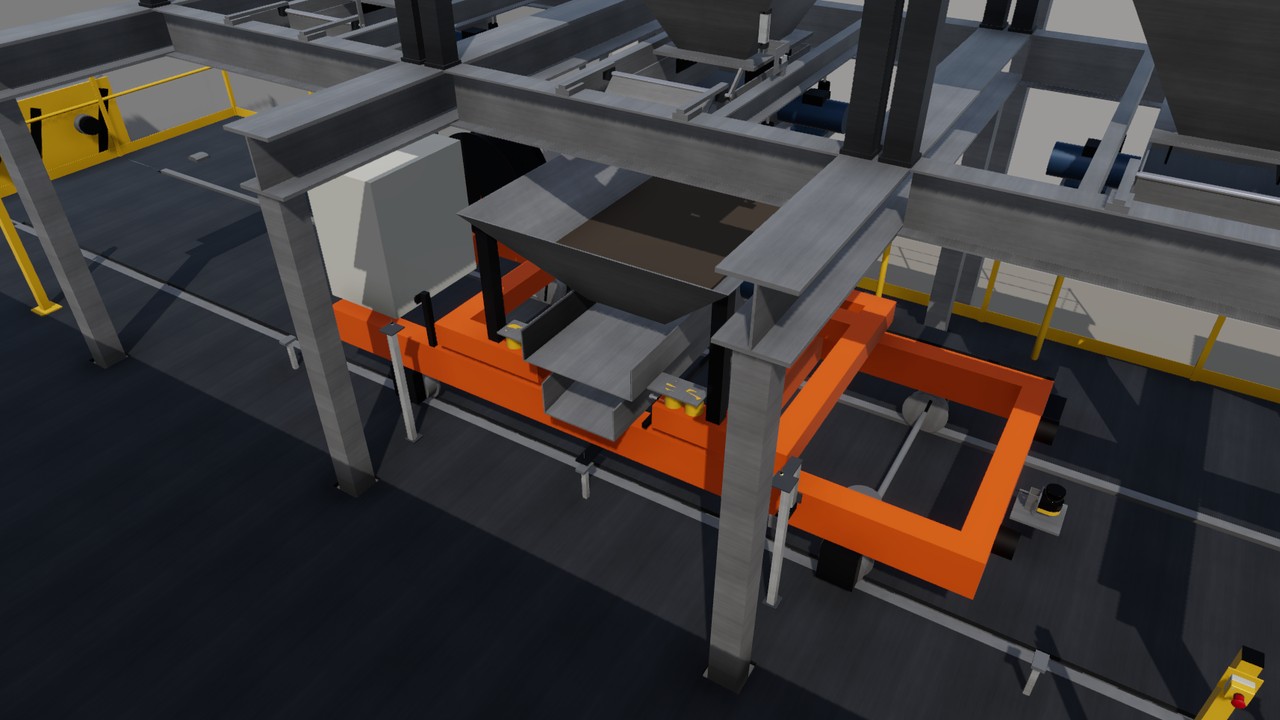
Step by step
- The car zeros its weigh hopper and moves to the first bin outlet.
- It stops within ± 5 mm. A vibrating feeder fills the hopper by weight.
- When the flap is closed, the car moves on and doses the concentrate.
- The chute moves in only when two sensors see the furnace lid open.
- The charge goes in for 5 minutes at 40 % furnace power.
- The chute moves out and the lid closes. The cycle takes about 9.6 minutes.
Specifications
The devices
Each device is a real catalogue product. Its own product page will follow on the products level.
| Device | Role |
|---|---|
| Compact PLC on the car | Controls the car's travel, dosing and feeding. |
| Load cells (4 x 1 t) | Weigh the hopper to about ± 1 kg. |
| Variable speed drives (3) | Drive travel, feeder and chute, with safe stop. |
| Inductive proximity sensors | Report car, chute and lid positions without contact. |
| Pneumatic flap cylinders | Move the flaps, which close if power fails. |
| Emergency stops and safety controller | Stop the drives and cut the furnace power. |
Links lead to the makers' public product pages and are given for reference only. This site is independent work, not affiliated with, sponsored or endorsed by any manufacturer. The makers are responsible for the content of their pages. Trademarks belong to their owners.
The signals
| Signal | Direction | Meaning |
|---|---|---|
| Hopper mass | to PLC | Weight of the hopper from four load cells. |
| Car at outlet | to PLC | Hopper under the outlet, so dosing may start. |
| Flap closed | to PLC | Car may leave only with all flaps closed. |
| Lid open seen by car | to PLC | Second lid proof, needed before the chute moves. |
| Chute in furnace mouth | to PLC | Blocks lid closing, limits power to 40 %. |
| Furnace power set point | from PLC | Furnace power, 0 to 3,000 kW. |
About this page
In the scenario, this hand-over charges every heat of 16 Psyche metal into the furnaces.
Real devices, built from real data
Every machine and device in this twin is a real industrial product from the makers' catalogues. They range from sensors, valves and drives to safety scanners, load cells and RFID readers. Each model is built from the product's published data: dimensions, sensing ranges, signals, rated values, parameters and timing.
The PLC programs use the devices' real interfaces and parameters. Before any hardware existed, the twin found hundreds of faults in the plant design and the programs. So a real commissioning would need fine tuning, not a redesign.