Overview
A robot stacks 90 ingots on a steel skid, and a machine straps them into one bundle.
Area 15 turns cast ingots into the export unit of the plant. A 6-axis robot stacks 90 ingots of 20.7 kg on a steel skid, a flat base frame. A machine binds the stack with three steel straps. Each bundle leaves weighed and tagged.
Ingots wait in a line at the pick stop. The robot lifts three at a time and builds five layers of 18. Conveyors move the stack through the strapping machine to a scale. A driverless vehicle then takes the bundle to rack loading.
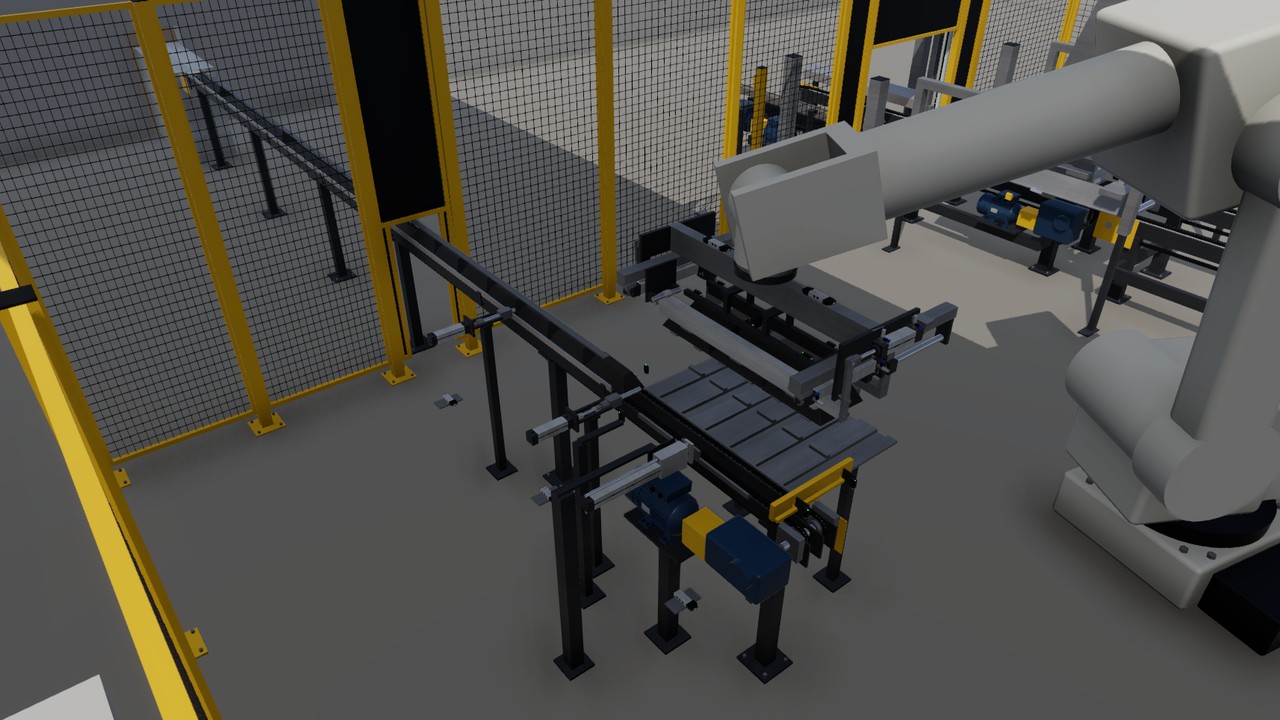
Process steps
- Marked ingots arrive from casting and wait in a line at the pick stop.
- A pusher lines up each row of three ingots against a guide rail.
- The robot places the 62.1 kg row on the skid, 30 picks per bundle.
- The strapping machine puts three steel straps around the bundle in 90 s.
- A scale checks the bundle mass against the 90 ingot records.
- A radio tag stores the bundle record, and a driverless vehicle takes it over.
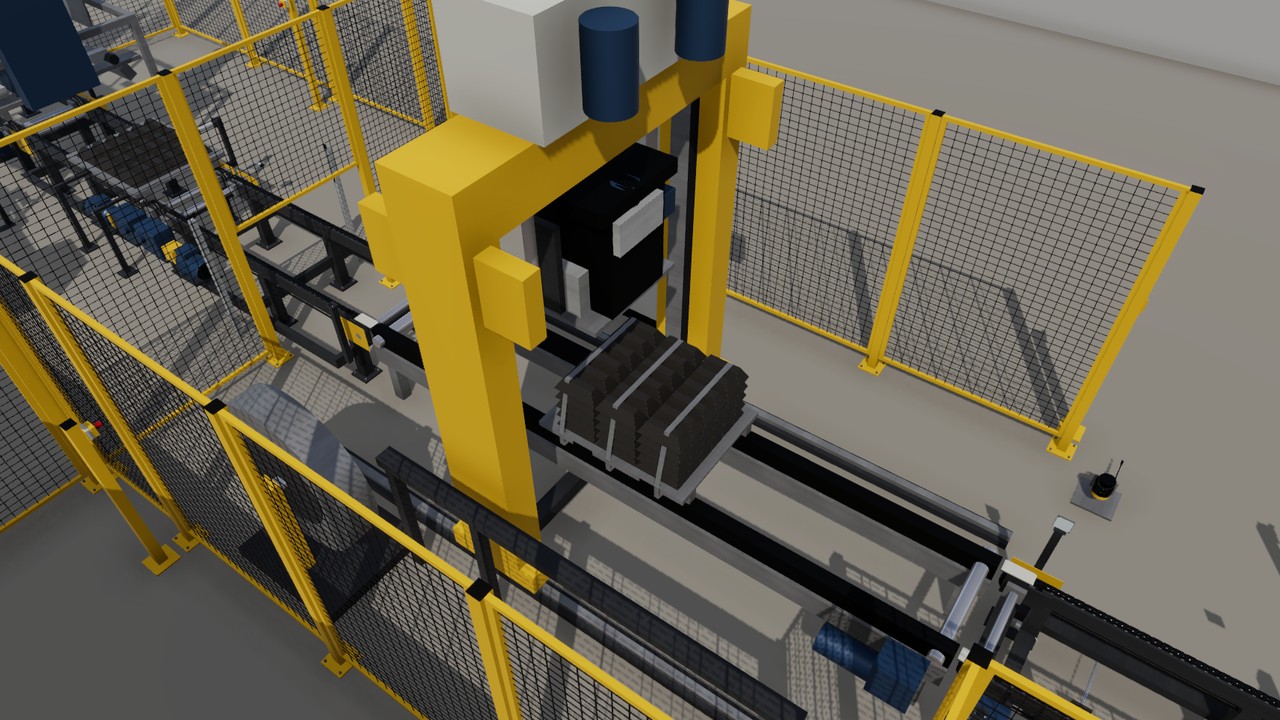
The line in the twin
Turning view
Specifications
The equipment list
| Unit | Function | Key data |
|---|---|---|
| 6-axis robot | Stacks rows of 3 ingots on the skid. | 3.2 m reach class, about 18 s per row |
| Ingot gripper | Clamps a row of 3 ingots with air cylinders. | Handles about 102 kg, 3 part sensors |
| Skid magazine | Holds empty skids and sets one on the conveyor. | 10 skids (3.0 h), skid 60 kg |
| Steel strapping machine | Feeds, tensions, seals and cuts 3 cross straps. | 32 mm strap, 10,000 N tension, 90 s per bundle |
| Bundle platform scale | Weighs each bundle and checks it against the ingot records. | Accepts 1,880 to 1,960 kg, 5 s per weighing |
| Radio tag reader | Writes the bundle record to the skid tag. | 48-byte bundle record, 1 s per write |
Links lead to the makers' public product pages and are given for reference only. This site is independent work, not affiliated with, sponsored or endorsed by any manufacturer. The makers are responsible for the content of their pages. Trademarks belong to their owners.
Control and safety
- If the gripper loses an ingot, the robot stops at a safe height and the cell stays locked.
- A bundle leaves only when its net mass matches the 90 ingot records within ± 0.5 %.
- Emergency stops, a locked door and laser scanners stop the robot, but the gripper keeps its grip.
- The single devices are modelled from the datasheet and tested against the PLC (control computer).
The hand-overs
| From | Marked 20.7 kg ingots from casting, 295 per hour on average, each with its record. |
| To | Strapped, weighed and tagged 1,923 kg bundles, 3.28 per hour, to the rack loading vehicle. |
The devices and signals
- One line PLC with 35 input and output terminals in 2 I/O stations.
- 134 signals: 56 digital inputs, 26 digital outputs, 11 analog, 24 safe inputs, 12 safe outputs and 5 others.
- The robot talks to the PLC through one fieldbus gateway: 8 bytes each way.
- 5 conveyor drives on hard-wired signals.
- Safety devices: 4 emergency stop stations, 1 light curtain with muting, 2 safety laser scanners and 1 cell door with guard locking.
- Process sensors: 15 photoelectric sensors, a bundle scale and a radio tag read head. The strapper is a machine with its own control.
The safety functions
- Emergency stop: the robot stops on its path (stop category 1), the conveyors by safe torque off (stop category 0). The gripper keeps its ingots.
- Cell door with guard locking: it unlocks only on request, with the robot at home and stopped. An open door gives a protective stop.
- Light curtain at the skid side: muting only while a skid stack passes the two crossed muting sensors in order. A lamp shows the muting.
- Scanners at the cell exit and at the vehicle station stop the robot or the conveyors. Data sheet rating: performance level d.
- Target: performance level d, a target and not a claim.
The tests run in the twin
- In test against the PLC since 2026-10-18. PLC unit test run 4 that day: 69 checks, 64 passed, 5 failed.
- Play sessions with the 3D scene from 2026-10-21. A sensor check found a real fault: a vehicle sensor saw the vehicle 8 m away.
- Window 7 (2026-10-27) stopped before any live change, because one sensor was missing in the scene. The fixed set is staged.
- Seven fault tests are defined, among them an emergency stop with 6 ingots in the gripper and an open safety channel.
About this page
In the scenario, this area packs the ingots of 16 Psyche into bundles for cargo flights to the Earth or local stock.
Real devices, built from real data
Every machine and device in this twin is a real industrial product from the makers' catalogues. They range from sensors, valves and drives to safety scanners, load cells and RFID readers. Each model is built from the product's published data: dimensions, sensing ranges, signals, rated values, parameters and timing.
The PLC programs use the devices' real interfaces and parameters. Before any hardware existed, the twin found hundreds of faults in the plant design and the programs. So a real commissioning would need fine tuning, not a redesign.