Overview
A battery rail cart sorts racks into cargo sets of 26 and feeds them to the pad tower.
Area 18 turns single racks into cargo sets of 26 racks and 49.0 t of net product, one set per ship. About 12 ships leave in each departure window, about every 15 months. The yard is designed for 312 racks in 12 lanes.
Racks arrive from rack loading with their record: identity, mass and centre of gravity. The cart places each rack in a set lane by the load plan, heavy racks first. For ship loading, it brings the racks one by one to the pad tower.
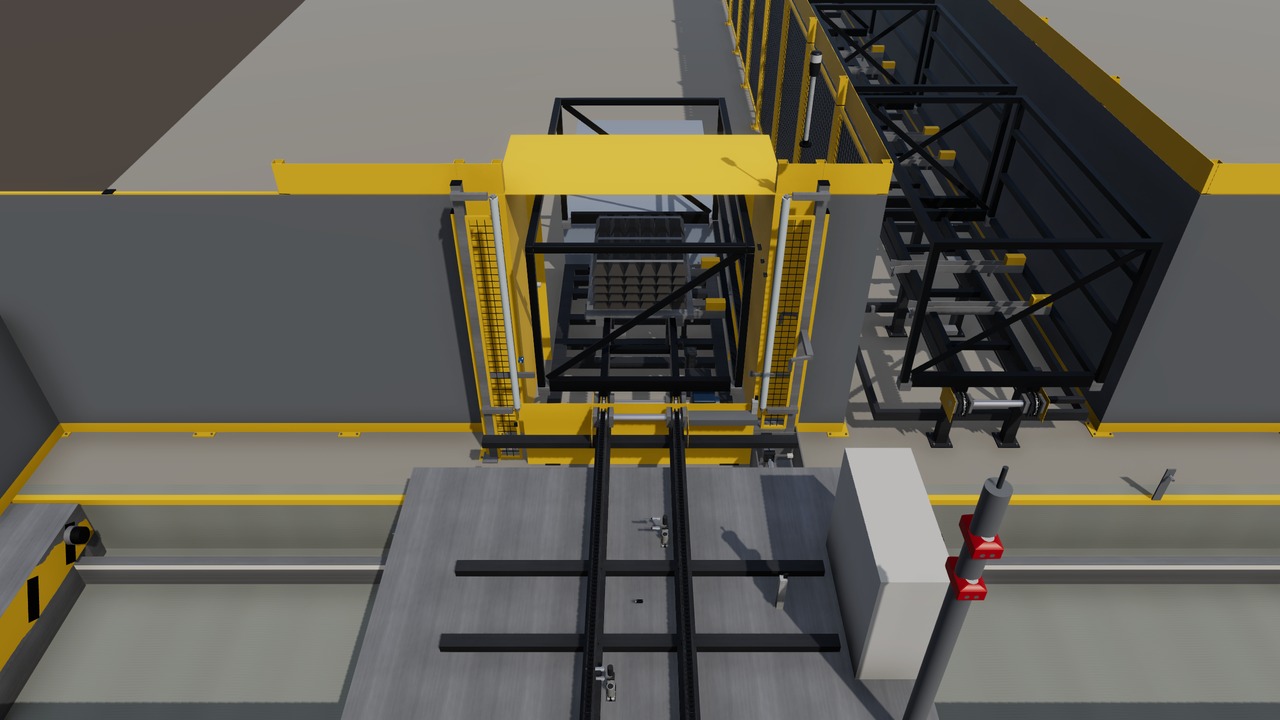
Process steps
- A loaded rack waits at the first dock with its rack record.
- The cart stops within ±3 mm, and a pin locks it in place.
- Both chains move the rack onto the cart, and lock pins hold it.
- The load plan picks the slot: heavy first, alternating sides of the cargo bay.
- The cart unloads into the set lane and returns an empty rack.
- Later the cart brings the racks in slot order to the pad tower.
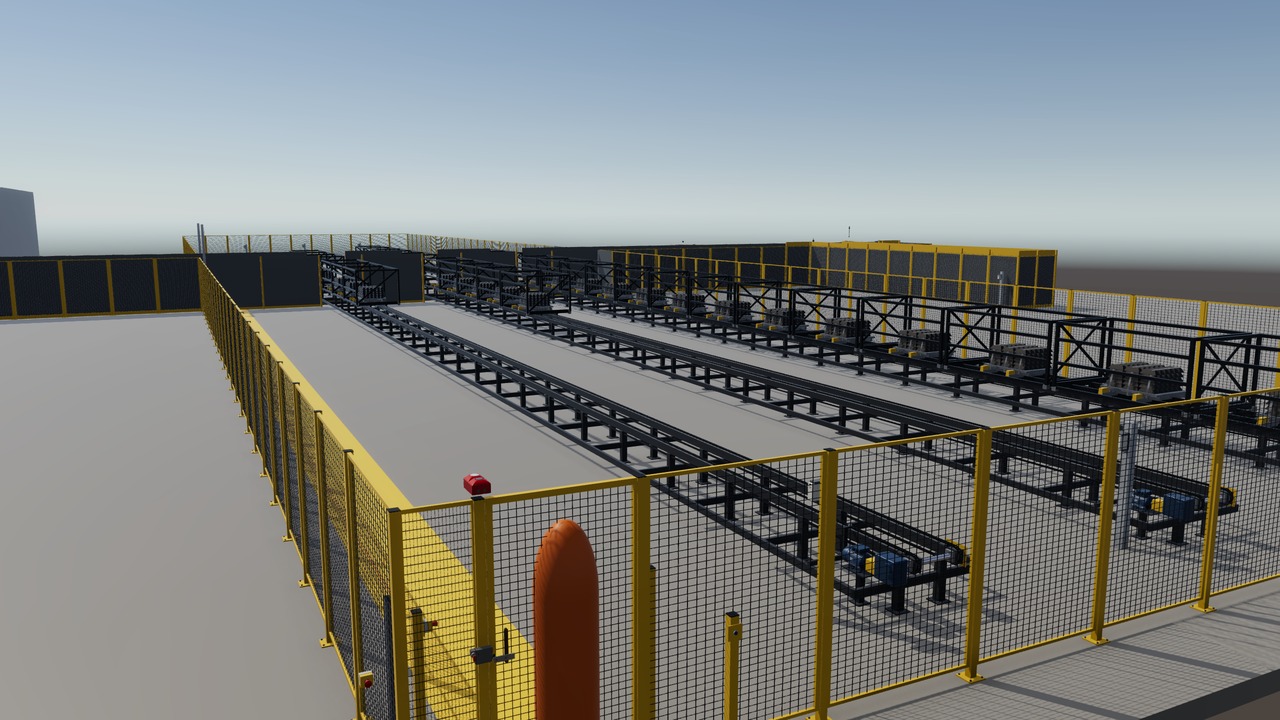
The line in the twin
Turning view
Specifications
The equipment list
| Unit | Function | Key data |
|---|---|---|
| Battery rail cart | Carries one rack at a time between docks and lanes. | 0.5 m/s loaded, 0.75 m/s empty, 5 t design load |
| Position measuring tape | Gives the exact rail position from a bar code. | Repeatable to 0.05 mm, stop within ±3 mm |
| Safety laser scanners | Protect people with fields that change with speed. | 1.5 m field when travelling, 0.3 m when docking |
| Battery and wireless charger | Charges the cart without contact at the rack loading dock. | 48 V, 4.8 kWh battery, 3 kW charger |
| Station index pins | Centre the cart and lock it in the dock. | Air cylinder, about 1,870 N, stays in if power fails |
| Set lane chain conveyors | Store the racks of each set, last in, first out. | Two half-lanes of 13 positions, 0.1 m/s |
Links lead to the makers' public product pages and are given for reference only. This site is independent work, not affiliated with, sponsored or endorsed by any manufacturer. The makers are responsible for the content of their pages. Trademarks belong to their owners.
Control and safety
- The design gives the yard and the cart their own PLC (industrial control computer).
- No safety signal uses the radio, and a pinned cart cannot drive.
- Eight fault test cases are specified, such as a person on the rail or radio loss.
- The single devices are modelled from their datasheets and tested against the PLC.
The hand-overs
| From | Weighed and tagged racks come from Area 17 (rack loading), 3.38 per hour. |
| To | Racks go one at a time in load-plan order to the pad tower of Area 19. |
The devices and signals
- Yard PLC: 17 input and output terminals in 1 I/O station, 113 signals: 41 digital inputs, 15 digital outputs, 45 safe inputs, 8 safe outputs and 4 others.
- Rail cart PLC: 20 terminals and 50 signals, with 3 servo drives.
- 7 lane conveyor drives on hard-wired signals.
- Safety devices: 3 emergency stop stations, 1 pull-rope switch, 2 light curtains with 4 muting sensors each, 8 coded safety sensors and a corridor gate with guard locking. The cart has 2 outdoor laser scanners and 2 bumpers.
- Process sensors: 24 proximity sensors, 12 photoelectric sensors and 3 radio tag read heads.
The safety functions
- Cart: two scanners with speed-dependent fields, bumpers and an emergency stop. A person in the field gives a controlled stop, then safe torque off and the brakes.
- Dock light curtains with muting: muting only while the transfer conveyors run. It ends when no muting sensor changes for 5 s.
- Corridor gate with guard locking: it unlocks only with a dock pin engaged and no transfer running.
- The only safe path between yard and cart is the dock coupling, live only while the cart is docked. Radio carries no safety function.
- Target: performance level d, a target and not a claim.
The tests run in the twin
- Scene built on 2026-10-26. Its probe found 5 real faults, for example a curtain beam that touched a conveyor strand.
- PLC program written on 2026-10-27, reviewed in rounds with a muting model, and put live on 2026-11-01.
- The first run with the rail cart in the 3D scene is the next step.
- Nine fault tests are defined, from a person crossing the rail to a broken coupling channel.
About this page
In the scenario, this yard prepares the cargo sets for the fleet that leaves 16 Psyche in each departure window.
Real devices, built from real data
Every machine and device in this twin is a real industrial product from the makers' catalogues. They range from sensors, valves and drives to safety scanners, load cells and RFID readers. Each model is built from the product's published data: dimensions, sensing ranges, signals, rated values, parameters and timing.
The PLC programs use the devices' real interfaces and parameters. Before any hardware existed, the twin found hundreds of faults in the plant design and the programs. So a real commissioning would need fine tuning, not a redesign.