What the station does
The cart stops within 3 mm, a pin locks it, and a 2.4 t rack crosses over.
At the dock, two machines meet, each with its own controller and safety system. They must agree before a 2.4 t rack moves across: the cart locked, both chains running together, nobody in the opening. No safety signal passes between them.
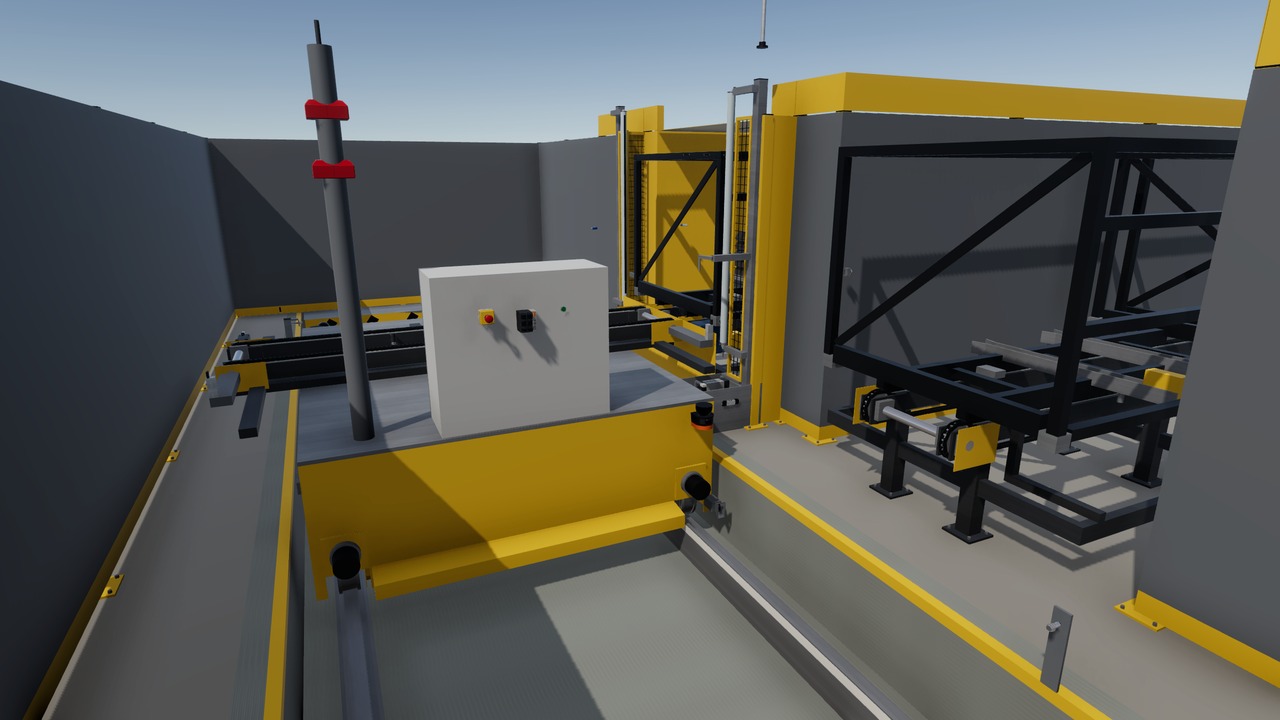
Step by step
- The cart comes in slowly at 0.1 m/s and stops within ±3 mm.
- Sensors confirm the cart, and its radio tag proves the identity within 0.5 s.
- The index pin extends and centres the cart, which then cuts its wheel drive.
- The cart lowers its lock pins, and both chains run together at 0.1 m/s.
- When the rack reaches the deck sensor, the lock pins rise into the rack.
- The index pin retracts only with the gate locked and the light curtain free.
Specifications
The devices
Each device is a real catalogue product. Its own product page will follow on the products level.
| Device | Role |
|---|---|
| Air cylinder with conical index pin | Catches, centres and locks the cart. |
| Proximity sensors and radio tag reader | Check cart presence and cart identity. |
| Light curtain | Safety light beams across the rack opening. |
| Station chain conveyor | Moves the rack to the cart, or back. |
| Cart motor drives (x3) | Drive two wheel axes and the deck chain. |
| Electric rack lock pins (x2) | Hold the rack on the deck. |
Links lead to the makers' public product pages and are given for reference only. This site is independent work, not affiliated with, sponsored or endorsed by any manufacturer. The makers are responsible for the content of their pages. Trademarks belong to their owners.
The signals
| Signal | Direction | Meaning |
|---|---|---|
| Cart present 1 and 2 | to PLC | Both on: the cart is in the dock. |
| Cart identity | to PLC | Must match the job before the pin extends. |
| Index pin extended and retracted | to PLC | Pin end positions, extended within 3 s. |
| Dock pin engaged 1 and 2 | to PLC | Keeps the wheel drive off on the cart. |
| Deck chain drive | from PLC | Deck chain speed, 0.1 m/s. |
| Lock pins extended and retracted | to PLC | Both extended: the rack is secured. |
About this page
In the scenario, every rack bound for Earth passes this dock on its way into the launch yard on 16 Psyche.
Real devices, built from real data
Every machine and device in this twin is a real industrial product from the makers' catalogues. They range from sensors, valves and drives to safety scanners, load cells and RFID readers. Each model is built from the product's published data: dimensions, sensing ranges, signals, rated values, parameters and timing.
The PLC programs use the devices' real interfaces and parameters. Before any hardware existed, the twin found hundreds of faults in the plant design and the programs. So a real commissioning would need fine tuning, not a redesign.