Overview
The cobalt and platinum-group residue is filled into 200 kg steel drums, sealed, tagged and palletised.
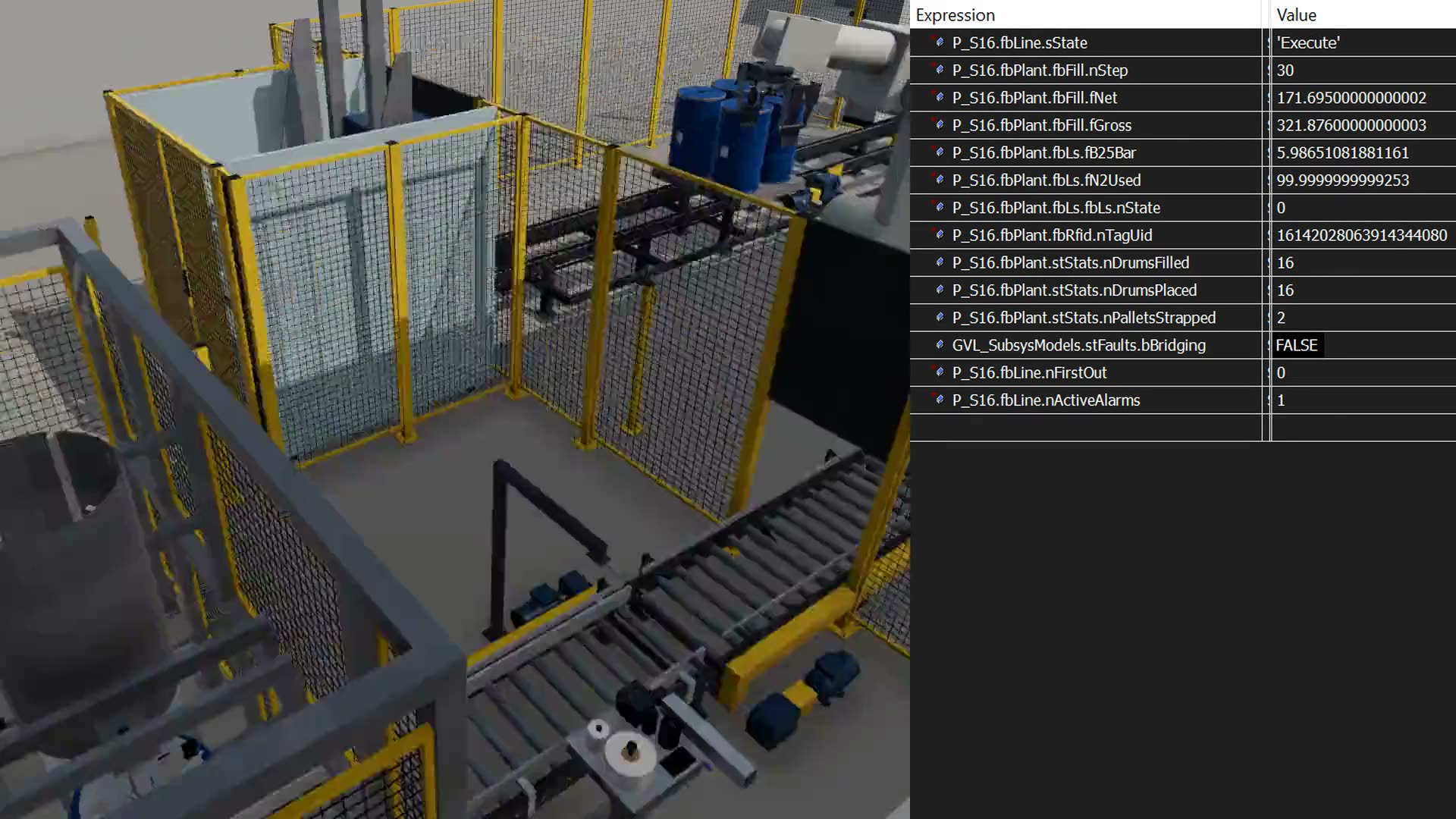
Area 16 packs the most valuable stream: about 80 kg per hour of dry powder with cobalt and platinum-group metals. The line is designed to fill it into 200 kg steel drums. Each drum must leave dry, sealed and traceable.
The powder waits in a 400 kg hopper. A dosing screw fills each drum on a scale, first fast, then slowly. The drum is flushed with dry nitrogen, closed, labelled and tagged. A robot sets four drums on a pallet, and a machine straps it.
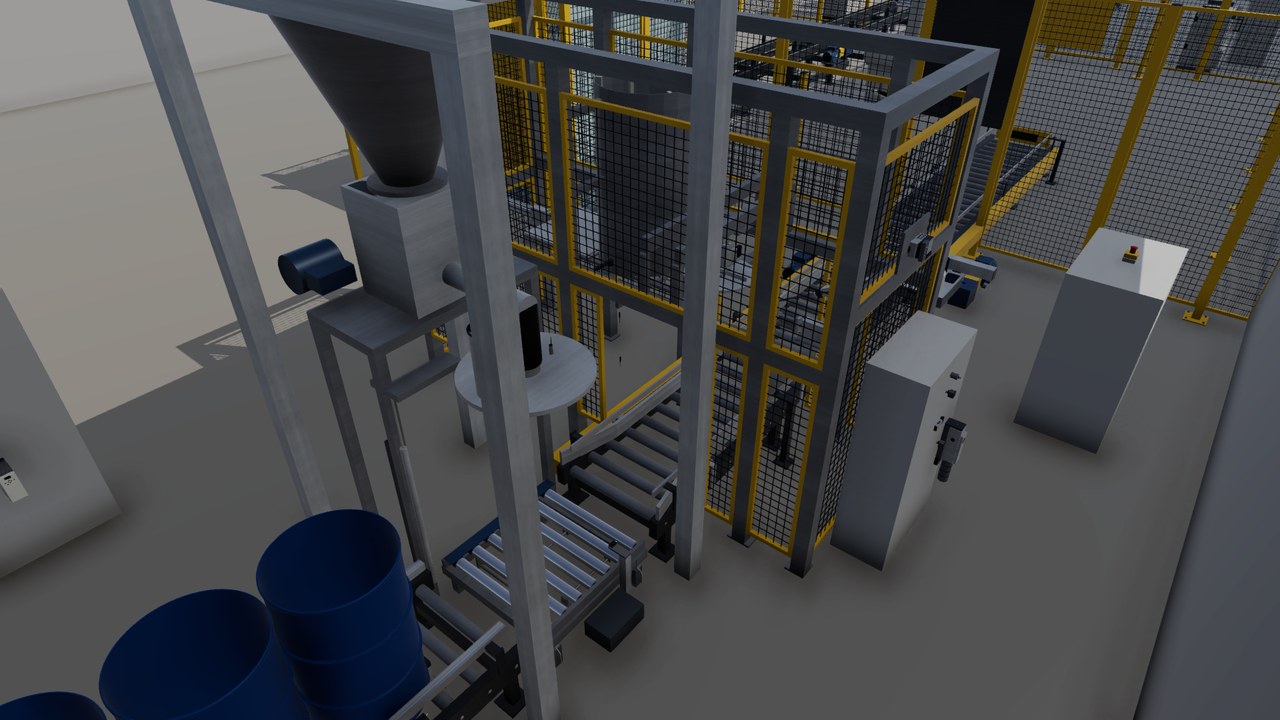
Process steps
- Residue powder from the refinery fills a 400 kg hopper.
- An empty drum rolls onto the scale, and the filling head seals its rim.
- A dosing screw fills fast to 190 kg, then slowly to 200.0 kg.
- Dry nitrogen flushes the drum, and a clamp ring locks the lid.
- A printer labels the drum, and its radio tag gets the drum record.
- A robot sets four drums on a pallet, and a machine straps the pallet.
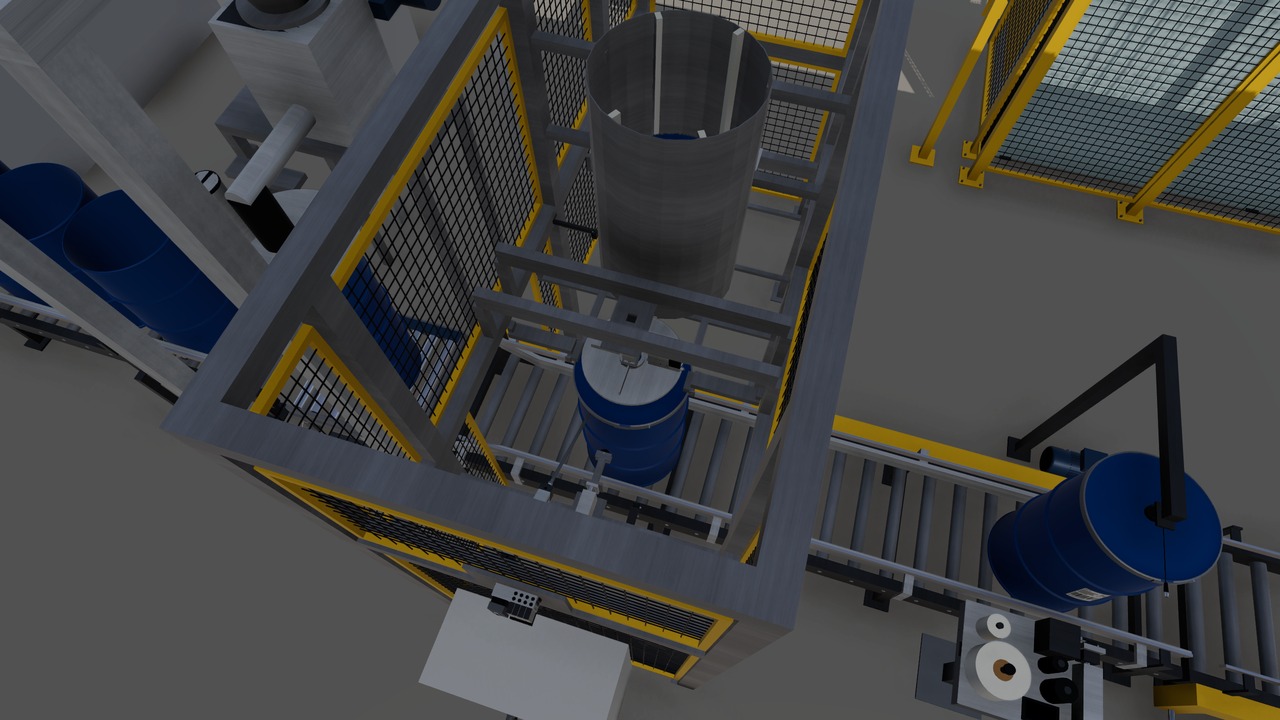
The line in the twin
Turning view
Specifications
The equipment list
| Unit | Function | Key data |
|---|---|---|
| Residue hopper | Buffers the refinery powder in front of the filling station. | 400 kg, 5 hours at 80 kg/h |
| Enclosed drum filling station | Fills each drum by weight through a dust-tight seal. | 45 then 13.5 kg/min, about 5 min per drum |
| Drum scale | Weighs the empty drum, the filling and the net mass. | Four load cells (weight sensors), 800 kg range |
| Lid station | Flushes the drum with nitrogen, closes and locks the lid. | 60 s purge, about 94 s per drum |
| Label printer and radio tag reader | Labels the drum and writes its record to the tag. | 20-byte record with id, masses, lots and fill time |
| 6-axis robot and strapping machine | Sets four drums on each pallet and straps the pallet. | Robot for 300 kg, strapping 90 s per pallet |
Links lead to the makers' public product pages and are given for reference only. This site is independent work, not affiliated with, sponsored or endorsed by any manufacturer. The makers are responsible for the content of their pages. Trademarks belong to their owners.
Control and safety
- The screw doses only when the seal holds, and it stops at once on overfill.
- The robot cell is guarded, and an emergency stop safely cuts the power of all six drives.
- Fault test cases are specified for blocked powder, overfill, a missing lid and an emergency stop.
- The single devices are modelled from the datasheet and tested against the PLC, the industrial control computer.
The hand-overs
| From | Dry residue powder from the refinery, about 80 kg per hour, with its lot record. |
| To | Pallets of four drums, 900 kg each, go by driverless vehicle to Area 17 (rack loading). |
The devices and signals
- One line PLC with 36 input and output terminals in 2 I/O stations.
- 161 signals: 64 digital inputs, 27 digital outputs, 3 analog, 37 safe inputs, 22 safe outputs and 8 others.
- The robot talks to the PLC through one fieldbus gateway: 8 bytes each way.
- 6 conveyor and dosing drives on hard-wired signals.
- Safety devices: 3 emergency stop stations, 7 safety laser scanners, 2 doors with guard locking and a safety position switch.
- Process sensors: a drum scale on 4 load cells, a radar level sensor, 12 photoelectric sensors, pressure sensors and a radio tag read head.
The safety functions
- Robot cell: a 2.2 m fence, a door with guard locking and a scanner at the pallet exit. The robot stops by category 1, the drives by safe torque off (category 0).
- Three dock scanners guard the vehicle hand-over. The transfer runs only with the dock area protected.
- Pallet dispenser: its own fenced area, an interlocked double door and a quick exhaust valve, performance level d, category 3, as its manual asks.
- Nitrogen purge only with the lance in the drum. A sensor proves that the valve closes.
- Target: performance level d for the cell guard and the emergency stop, a target and not a claim.
The tests run in the twin
- In test on the second PC since 2026-10-19. First unit test run: 37 checks, 35 passed, then the PLC runtime stopped with a fault.
- Play sessions 5 to 16 with the 3D scene, the last on 2026-11-01.
- Eleven fault tests are defined, from an emergency stop with a drum in the gripper to a seized gripper jaw.
About this page
In the scenario, this line packs the most valuable residue of 16 Psyche in sealed drums for the trip to Earth.
Real devices, built from real data
Every machine and device in this twin is a real industrial product from the makers' catalogues. They range from sensors, valves and drives to safety scanners, load cells and RFID readers. Each model is built from the product's published data: dimensions, sensing ranges, signals, rated values, parameters and timing.
The PLC programs use the devices' real interfaces and parameters. Before any hardware existed, the twin found hundreds of faults in the plant design and the programs. So a real commissioning would need fine tuning, not a redesign.