Why this project exists
This project exists to show, in one complete case, how I engineer and build digital twins of industrial plants. The scenario is fiction. The engineering is the work of a real project:
- The plant concept and the layout
- The selection of industrial devices from the makers' catalogues
- The safety planning: zones, muting, safety scanners and switches, the emergency stop chain
- The interconnections: I/O lists, fieldbus topology, signal and parameter lists, the interfaces between machines and areas
- The PLC programs for every area
- The device models with their real behaviour
- The test campaigns that run the whole plant in the twin before any hardware exists
The goal is a plant that a commissioning team could take to site with fine tuning, not a redesign.
Overview
The plant is designed as one system of 10 process areas. It takes 10 t/h (tonnes per hour) of dry, metal-rich ore. It makes marked iron-nickel ingots, sealed drums of cobalt and platinum-group residue, and racks ready for launch. The rock becomes building material.
Two 3 t induction furnaces set the pace: one furnace load every 29 minutes. The mass balance closes within 1 %, and 95.2 % of the metal ends up in product. Every ingot can be traced from furnace load to ship slot.
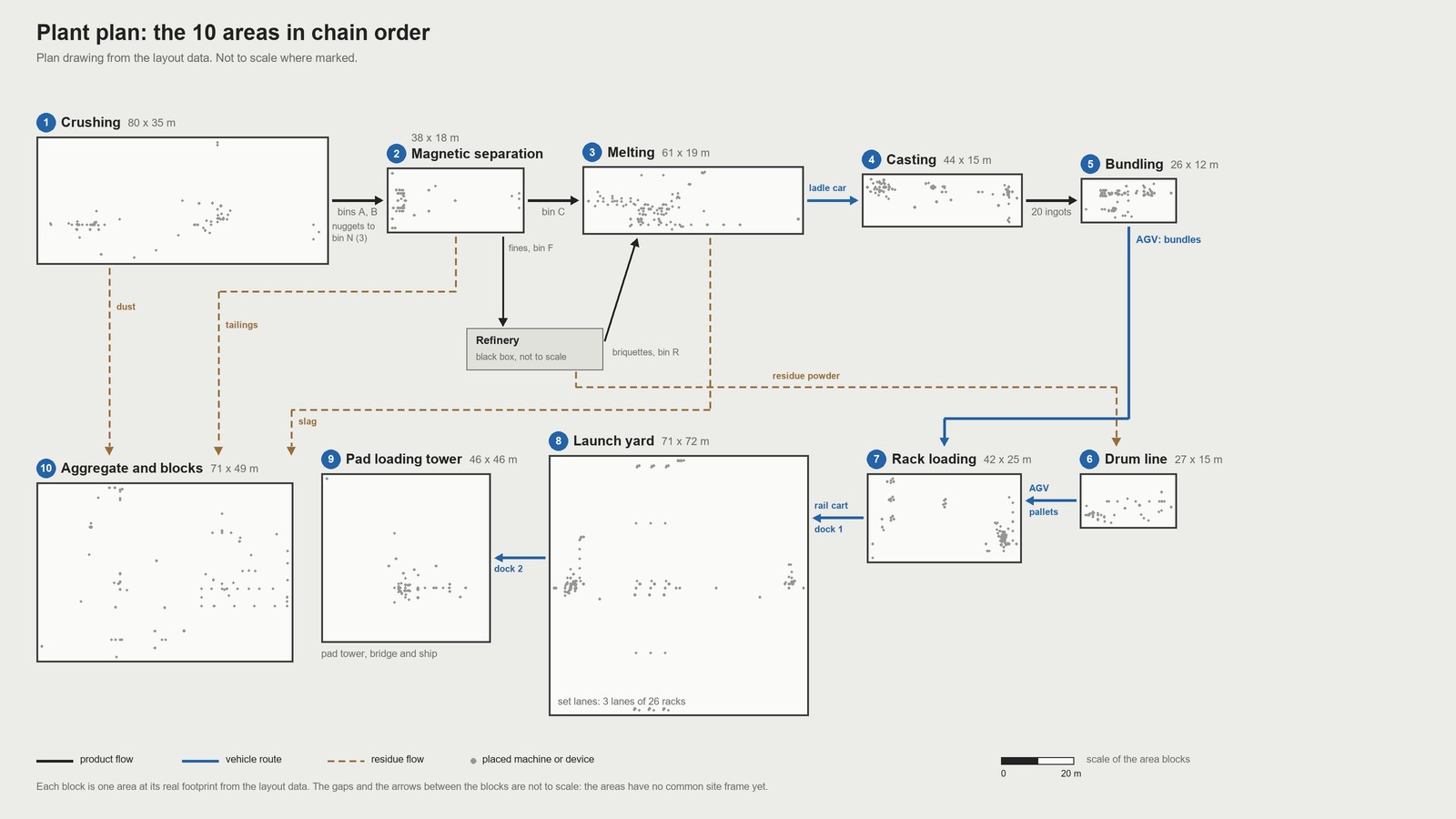
The steps of the chain
- Primary crushing and screening: Frees the metal from 10 t/h of ore.
- Dry magnetic separation: Magnet drums recover 96.2 % of the metal.
- Induction melting: Two 3 t induction furnaces melt in turn.
- Chain ingot casting: 295 marked ingots of 20.7 kg per hour.
- Ingot bundling and strapping: A robot stacks bundles of 90 ingots.
- Residue drum filling and palletising: Cobalt and platinum-group residue in sealed drums.
- Cargo rack loading and weighing: Racks are loaded, then weighed at four corners.
- Launch yard and cargo set staging: A rail cart builds sets of 26 racks.
- Pad loading tower: Loads 26 racks in about 1.7 h.
- Aggregate and building blocks: Rock, dust and slag become aggregate and blocks.
Flow and capacities
The material flow
| From | To | What | Rate |
|---|---|---|---|
| Primary crushing and screening | Dry magnetic separation | Rock and metal, two size fractions | 5.20 t/h (3 to 12 mm) and 3.20 t/h (below 3 mm) |
| Primary crushing and screening | Induction melting | Metal nuggets above 12 mm | 1.50 t/h |
| Dry magnetic separation | Induction melting | Coarse metal-rich product, 96.6 % metal | 3.54 t/h |
| Refinery unit | Induction melting | Iron-nickel briquettes | 1.33 t/h |
| Induction melting | Chain ingot casting | 3 t ladle of liquid metal | 6.23 t/h, 2.07 furnace loads per hour |
| Chain ingot casting | Ingot bundling and strapping | Weighed and marked 20.7 kg ingots | 295 ingots/h (6.11 t/h), 600 ingots/h at peak |
| Ingot bundling and strapping | Cargo rack loading and weighing | Strapped 90-ingot bundle, 1,923 kg gross | 3.28 bundles/h |
| Cargo rack loading and weighing | Launch yard and cargo set staging | Loaded, weighed and tagged rack | 3.38 racks/h |
| Launch yard and cargo set staging | Pad loading tower | Racks in load plan order | 9.9 racks/h while feeding the pad |
| Pad loading tower | Cargo ship | Rack locked in its bay slot | 1 rack every 4 min, 26 racks (49.0 t) in about 1.7 h |
| Dry magnetic separation | Aggregate and building blocks | Leftover rock | 3.33 t/h |
| Induction melting | Aggregate and building blocks | Slag, 135 kg per furnace load | 0.28 t/h |
The capacities
| Operating pattern | One 8 h shift per day, 250 days per year |
| Furnace pair, the bottleneck | 2 x 3 t, 2.07 furnace loads per hour, tapped at 1,580 °C |
| Ingots | 295 per hour (6.11 t/h), 20.7 kg each |
| Cargo sets | 1.05 per shift at full rated speed, 26 racks and 49.0 t net each |
| Ingots per year at full rated speed | 12,220 t |
| Export per transfer window | 12 cargo sets, about 590 t |